Home › Guides › How to play barre chords: getting F and Bm to ring clean
How to play barre chords: getting F and Bm to ring clean
Why barre chords are hard, how to angle the index finger, step-by-step technique for F and Bm, the causes of buzzing, and capo or short-shape workarounds while you learn.
A barre chord is any chord where the index finger presses more than one string at the same fret. F, Bm, F#m, Bb, C#m — all belong to this family, and it is the first wall every beginner hits. The difficulty is not strength; it is angle and placement. This guide explains why barres are hard, walks through F and Bm, and ends with ways to play the song while the barre is still cooking.
Why barres are hard
In an open chord each finger presses one string close to the wire. In a barre the index finger presses six strings at once, and the strings that fall under its knuckle creases go dead. The usual beginner reaction is to squeeze harder; the actual fix is to roll the finger slightly onto its side (the bony edge) and to place it right against the fret wire. Squeezing tires you out; the right spot rings clean with very little force.
F, step by step
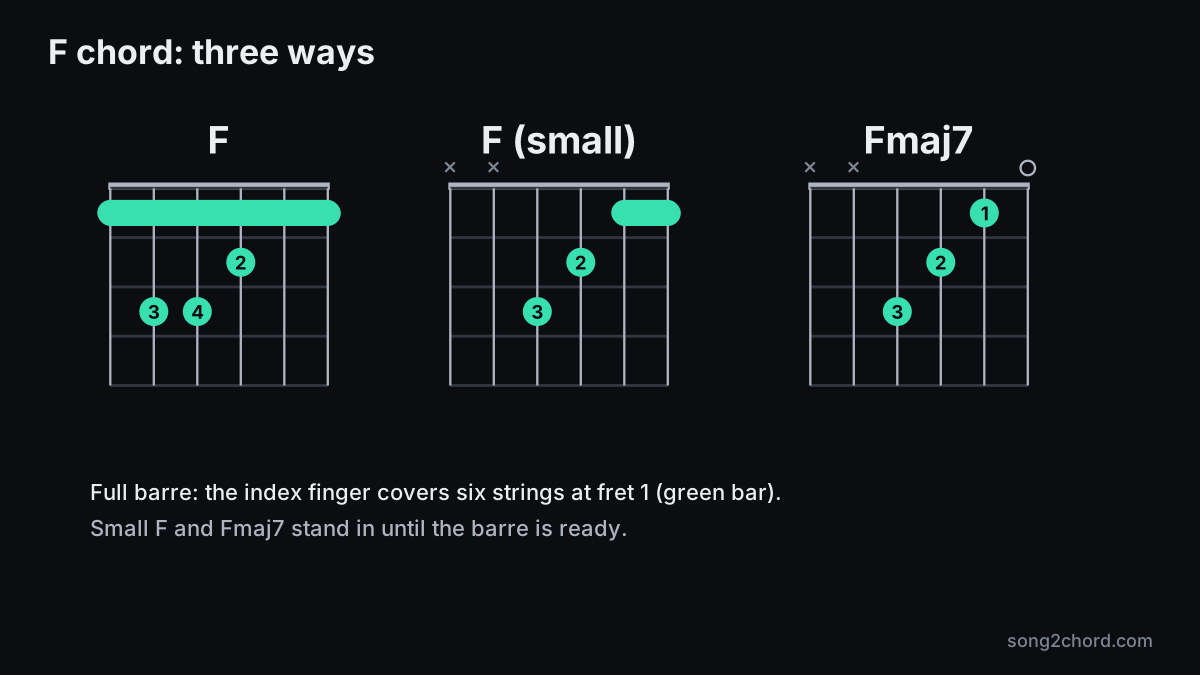
- Start without the barre: string 3 fret 2 (middle), string 4 fret 3 (ring), string 5 fret 3 (pinky). That trio is the E shape moved up one fret.
- Lay the index finger across fret 1, touching the wire; rotate it a little toward the thumb so the bony side meets the strings.
- Put the thumb behind the neck directly opposite the index finger. The force comes from the pinch between thumb and index, not from the wrist.
- Pick the strings one by one. Strings 2 and 3 usually go dead: slide the index finger a millimetre up (toward the bass strings) so the creases miss the strings.
- Hold for a minute, release, hold again. Stop if the hand cramps; a barre is coordination, not muscle, and five minutes a day settles it in two weeks.
Bm
Bm is the A-minor shape with a barre: index across strings 1–5 at fret 2, middle on string 2 fret 3, ring on string 4 fret 4, pinky on string 3 fret 4. Skip string 6. It has one advantage over F — five strings instead of six, so the index finger spreads less — and one drawback: ring and pinky sit side by side in the same fret, so keep them upright or string 2 dies. The same shape gives Bbm at fret 1, Cm at fret 3, Dm at fret 5.
Three causes of buzzing
- Pressing mid-fret. Move the finger to the wire.
- Finger lying flat. The creases land on strings; roll the finger or shift it a millimetre.
- Palm wrapped around the neck. If the thumb is over the top, the pinch is gone. Thumb behind, in the middle.
Playing the song before the barre is ready
- Capo. A song that runs F–C–Dm–Bb becomes D–A–Bm–G with a capo on 3; Bm is still a barre but F and Bb are gone. Our pages compute the capo fret that leaves the fewest barres — see the capo guide.
- Small F. Top four strings only: string 1 fret 1 and string 2 fret 1 (index covers both), string 3 fret 2, string 4 fret 3. Do not strum the bass strings. Thinner, but the song moves.
- Fmaj7. The small F with string 1 left open. It replaces F in most pop songs with no barre at all.
- Transpose. Two semitones down turns F into Eb — worse. One whole tone up turns F into G, Bb into C, Dm into Em, and every chord opens up. If the new key suits your voice, transposing is the cleanest fix. See transposing.
A plan to learn barres for good
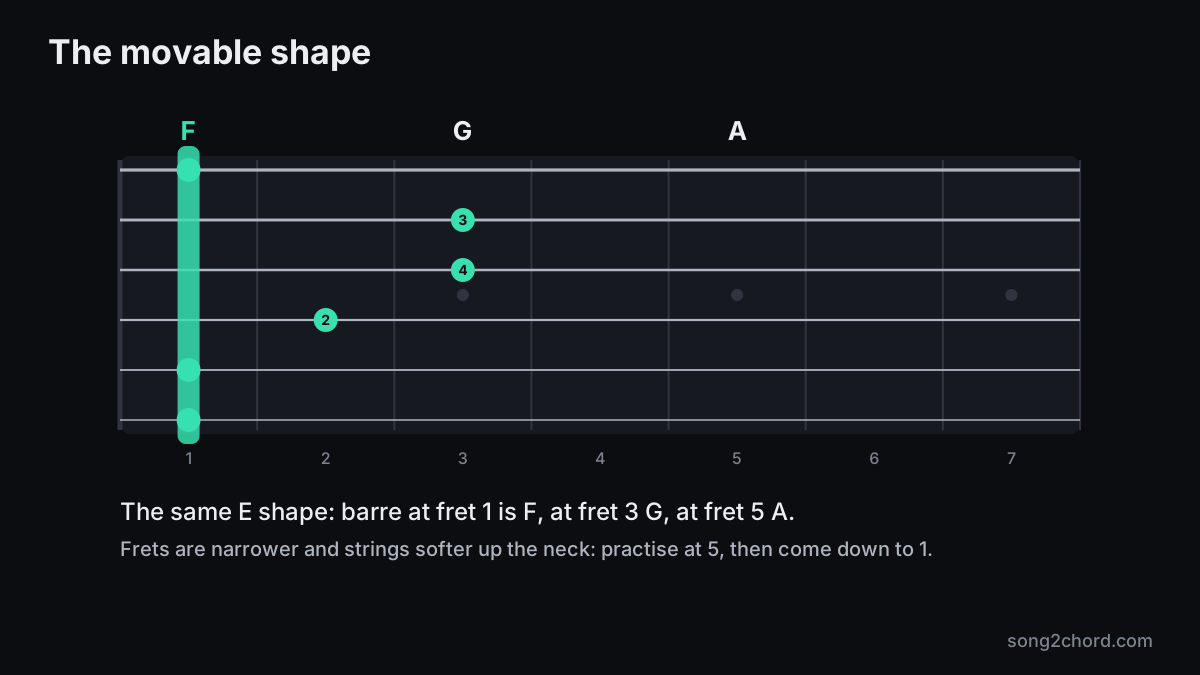
Five minutes a day: F at fret 1, then the same shape at frets 3, 5 and 7. Higher up the frets are narrower and the strings softer, so the barre gets easier; once it rings at fret 5 it starts ringing at fret 1 too. Then apply it in a song: the songs with F and songs with Bm lists include "easy" songs that contain exactly one barre chord. In karaoke mode loop the section where the chord appears, play it slow, speed up.