Home › Blog › Music theory for drums: simple, practical, useful
Music theory for drums: simple, practical, useful
The drum kit, how to read drum notation, note values, 4/4 and 6/8, counting, the backbeat, the basic rock beat, rudiments, fills and how to practise — short and plain.
Drum theory isn't hard. You only need a few things to read a chart and play it. This guide covers them in order. It's short. At the end you can open a song and try it right away.
The kit: five main pieces
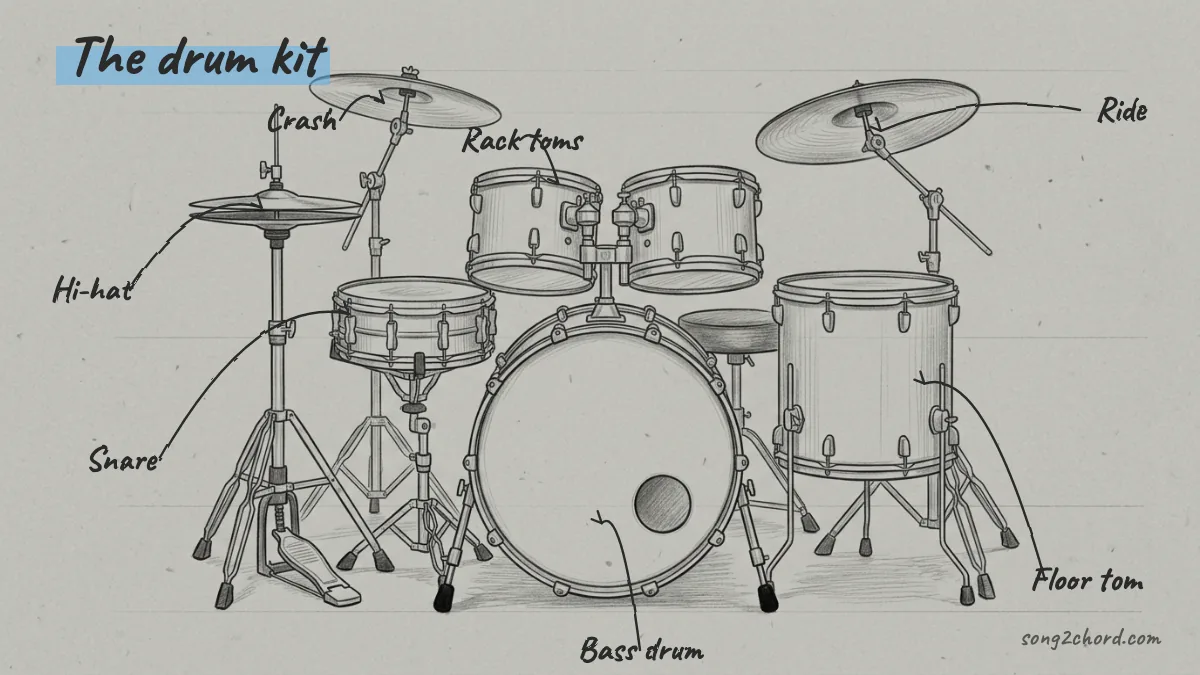
- Kick (bass drum): right foot. The lowest sound.
- Snare: left hand. Sharp and dry.
- Hi-hat: two cymbals opened and closed with the left foot. Played with the right hand.
- Toms: two rack toms in the middle, the floor tom on the right. Used in fills.
- Cymbals: crash for accents, ride for steady time.
How to read drum notation
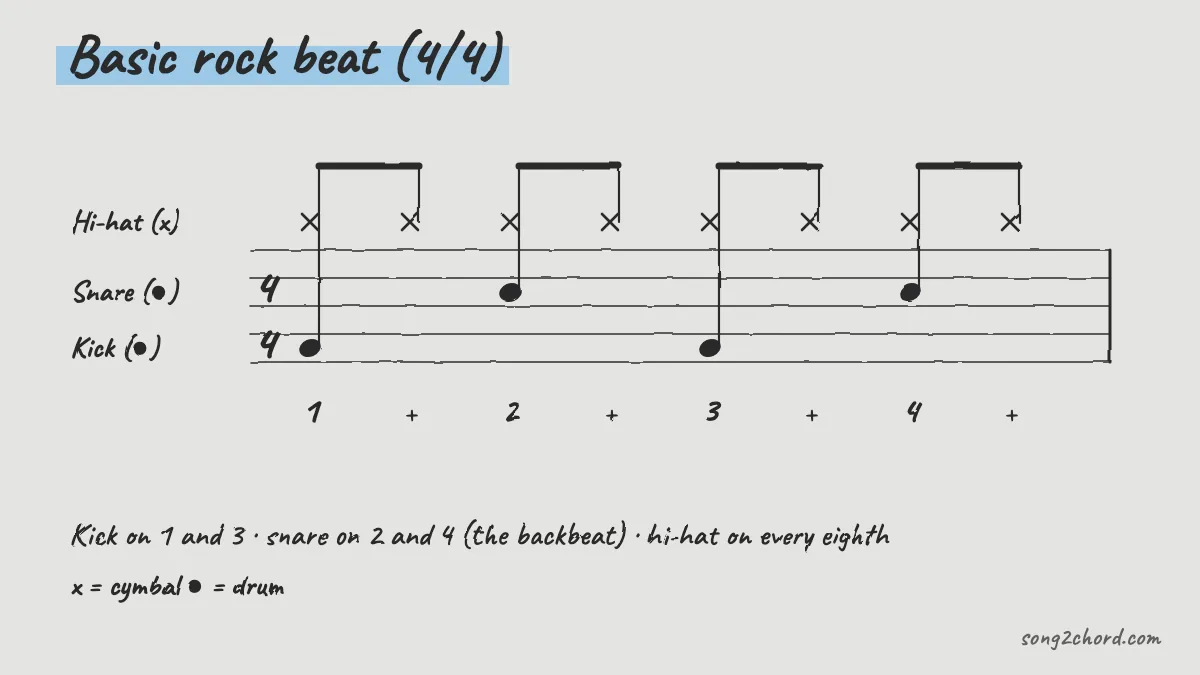
Each piece has its own line. Two symbols are enough:
- x is a cymbal: hi-hat, ride, crash.
- ● is a drum: snare, tom, kick.
Cymbals sit on the top lines, drums below. The kick is at the bottom.
Note values
They tell you how long a note lasts. In 4/4:
- Whole: 4 beats.
- Half: 2 beats.
- Quarter: 1 beat.
- Eighth: half a beat.
- Sixteenth: a quarter of a beat.
Time signatures: 4/4, 3/4, 6/8
The top number is beats per bar. The bottom number is which note counts as one beat.
- 4/4: four beats. Almost all of pop.
- 3/4: three beats. A waltz.
- 6/8: six eighths, two big beats. A rolling feel.
Counting
Count out loud. Your hands follow the count.
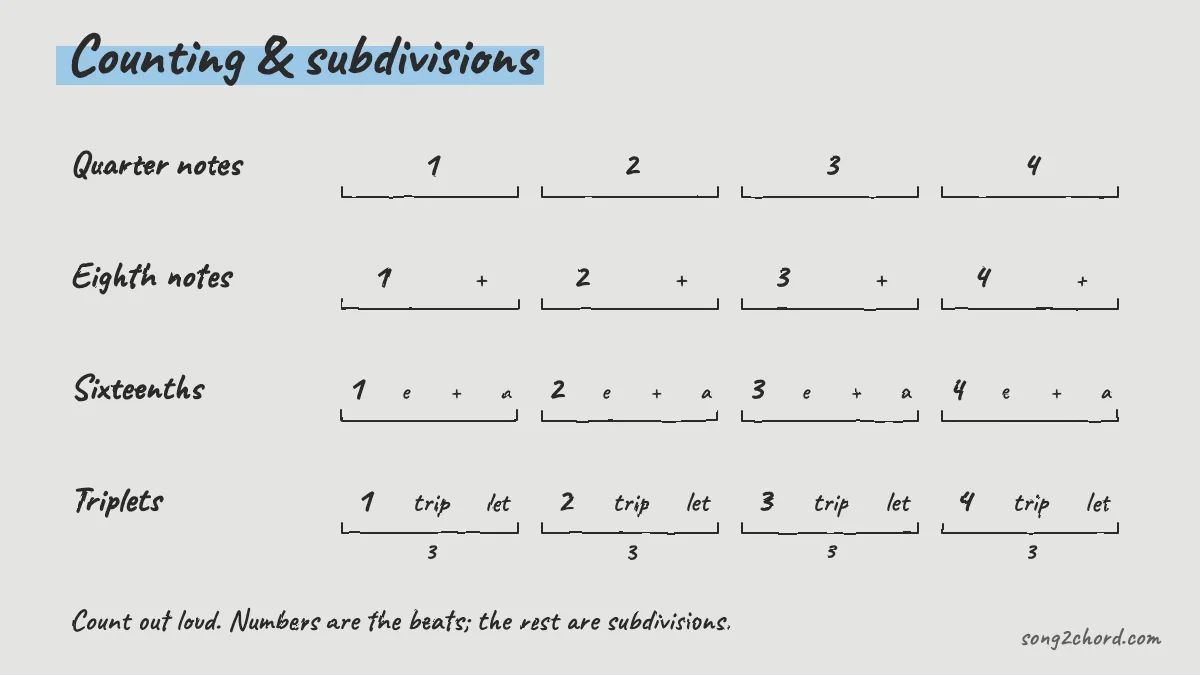
- Quarters: 1 2 3 4
- Eighths: 1 & 2 & 3 & 4 &
- Sixteenths: 1 e & a 2 e & a…
- Triplets: three notes in the space of two. 1 trip-let 2 trip-let…
Groove: backbeat and downbeat
The snare plays on 2 and 4. That's the backbeat. It pushes the song forward.
The kick plays on 1. That's the downbeat. It marks the start of the bar.
Keep the hi-hat steady: eighths or sixteenths. Play with loud and soft. Feel the pulse more than the notes.
Rudiments
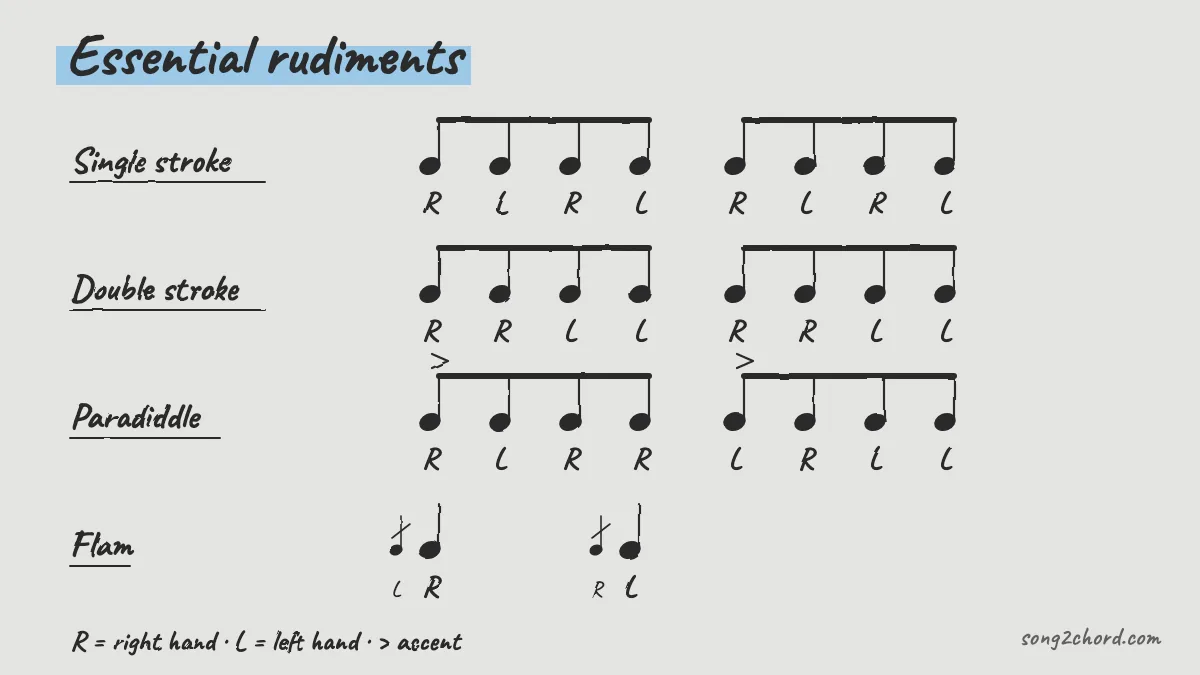
Rudiments are hand exercises. They build control, speed and endurance.
Fills
A fill is a short phrase between sections. Start with four or eight notes.
Move down the toms: rack tom, then floor tom. End the fill with a crash on the 1 of the next bar.
Keep it musical. A fill is a bridge, not a show.
Patterns by style
- Rock: kick on 1 and 3, snare on 2 and 4, hi-hat in eighths.
- Hip hop / R&B: the same skeleton, laid back. Kicks move onto the eighths.
- Metal: double pedal. The kick runs in sixteenths.
- Shuffle: a triplet feel. Long-short, long-short.
How to practise
- Start slow. Speed up once it's clean.
- Use a metronome.
- Play rudiments every day.
- Work on hand and foot independence.
- Record yourself and listen back.
- Play along with songs.
Try it with a song
Every song page has a Drums tab with the hits written out bar by bar. Upload your own song and you can mute the drum channel and play the part yourself.
To start, browse easy songs. Steady 4/4 pop songs are ideal for a first groove.